Showing posts with label Doha. Show all posts

Thursday, March 25, 2010

Poor porbeagle - no marine species listed under CITES at CoP15

In a shocking turn of events, the CITES parties reversed their earlier (GOOD, SOUND) decision to list porbeagle sharks, prized for their meat, under CITES Appendix II. No ban, just sound management measures in place for trade to be allowed. Obviously, this was clearly a crazy idea, once countries had a day or so to think about it, and so today in plenary, the vote was reversed. 84 were in favour of protection, 46 against and 10 abstentions. (You need 2/3rds majority for a vote to pass). The only other time this has happened was the red and pink coral vote at CoP14. Industry groups were thrilled that time, and now this time. The Japanese Fishing Association sitting in front of me broke into applause.

But let's look at it this way - many, many countries were in support of this proposal. More countries were in support of porbeagle protection, red and pink coral protection and hammerhead protection than they were against. That makes me proud of all those countries who considered the science and found it was sound, and pushed 'yes' for these species (on a related note, SeaWeb's Melanie Siggs pointed out to me that it's so odd to be voting on these species, as if we own them, and I agree). We now have to hold these industries and regulatory bodies responsible. ICCAT made a statement that said something along the lines of 'we base our decisions on sound science, we now have a clear mandate to conserve bluefin tuna." (Picture above.) When did you NOT, ICCAT? We'll be watching, and we'll be back at CoP16 if things don't start to turn around.

In the meantime, we must, as consumers, refuse to purchase red and pink coral, bluefin tuna, and none of you better be ordering any shark fin soup. There is simply no guarantee that the trade in these species is at all sustainable. Right now we need to take the precautionary approach. It's an interesting concept, countries-opposed-to-CITES-listings-for-marine species. You might want to consider it. And for the umpteenth time, these App II proposals for sharks and corals would not have been a ban on trade (the bluefin App I proposal, which DOES ban international trade, was much-deserved and needed). Perhaps if we had heeded Sweden's 19992 proposal to list Atlantic bluefin under Appendix I, we would not be where we are now. And trade in red and pink corals, for example, could have continued under Appendix II. Now it continues, regardless, unchecked and unregulated....and unsustainable - for these species and the people that depend on them.

Early Morning Doha Fish Market Visit

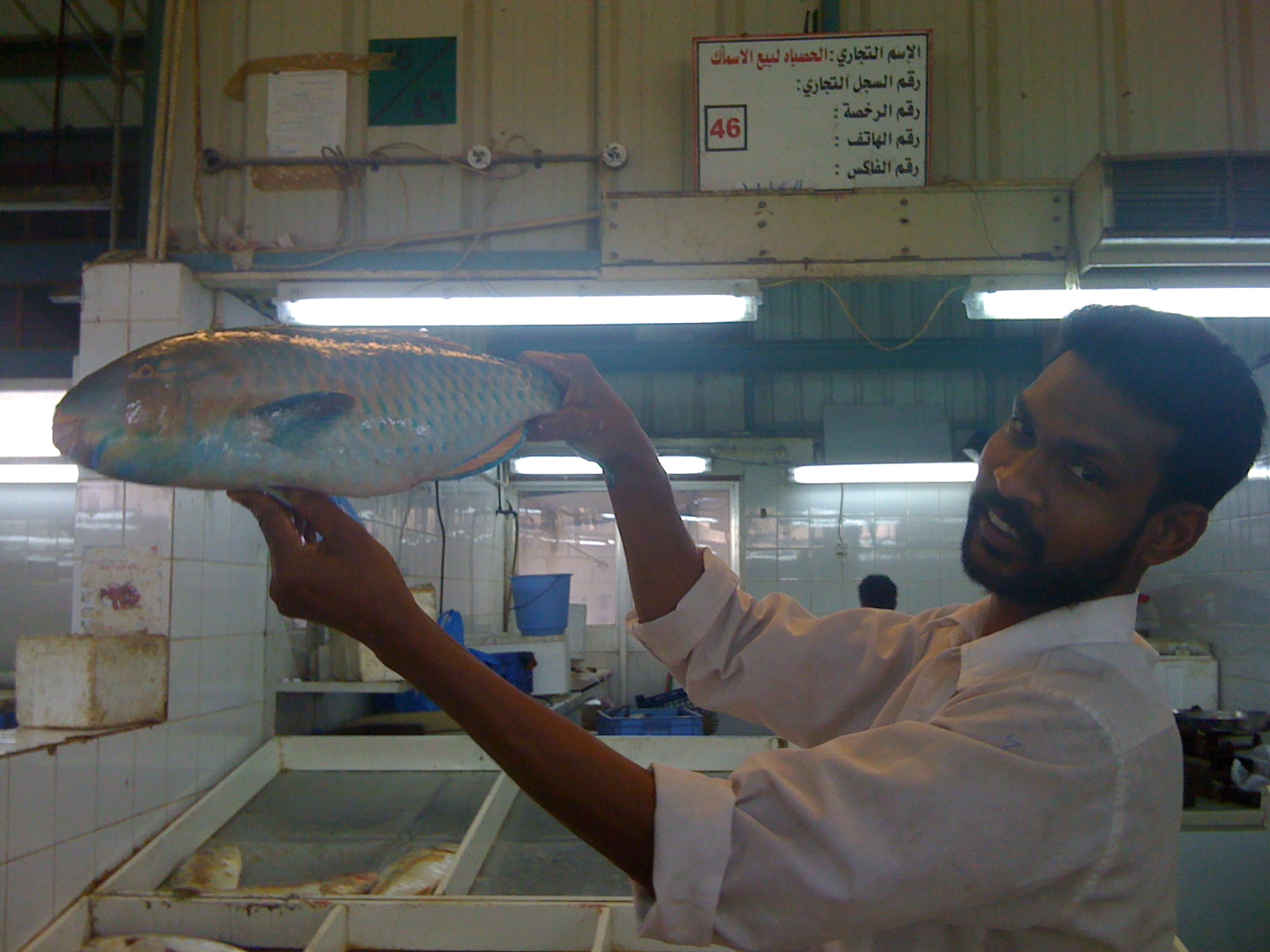
At o'dark thirty this morning, Phaedra and I dragged ourselves to the Doha Fish Market. Very interesting indeed. Lots more tropical fish compared to what I normally see in the northern European fish markets.

Above are some gorgeous parrotfish which apparently are from "Doha." The traders, while lovely and nice, said that everything was "from Doha."

Rays, above.

A very cheery trader holding up one of his prized rays. Now, these might actually be from Doha. When I went to the Islamic museum last week, we saw a couple of cow-nosed rays in the bay.

More parrotfish...I love how they look like they're smiling. Did you know that some species of parrotfish secrete a mucous cocoon at night to mask its scent from predators? I didn't until I checked Wikipedia just now....

Groupers. According to the traders, groupers are what they call "hamour."
It's a menu item you see in almost every restaurant.

More parrotfish and a happy trader.


Needlefish. My trusty (or possibly not) Wikipedia page says that needlefish can jump out of the water at up to 38mph and tend to get excited by artificial light, so pose a threat to some fishermen, particularly in the Pacific Islands. They can get 'speared' when the fish try and jump over their boat.

A very wee shark that should still be in the water. We need Sonja Fordham from the IUCN Shark Specialist Group to tell us what kind it is.


Guitarfish! How cool are they....

Tuesday, March 23, 2010

The FAO panel is providing political cover, nothing more (for the moment)

The FAO ad-hoc advisory panel on commercially-exploited aquatic species for consideration under CITES. Still with me or did you fall asleep? Yes, it's a long title for what is essentially a panel. And this will be a heavy post. But holy endangered species, there is A LOT of emphasis (for better or for worse) on the panel's recommendations when you start talking CITES.

A quick refresher on FAO. It's the United Nations Food and Agricultural Organization. It has a dedicated fisheries and aquaculture department whose mission is to "facilitate and secure the long-term sustainable development and utilization of the world's fisheries and aquaculture." FAO attempts to promote solutions to advance this mission, and a great deal of its work is monitoring, collecting and analyzing data from the world's fisheries and fish farming productions (see its SOFIA report). Its relationship with CITES has been contentious at times, because of a Memorandum of Understanding that was adopted between FAO and CITES in July 2006. The MOU essentially said that FAO and CITES should coordinate their efforts better, since a lot more marine species were increasingly being put forward for CITES protection (the need for FAO input on marine issues was first raised in 1997 at CoP10).

So from this MOU it was agreed that FAO would convene a bunch of experts to weigh in on the marine species being proposed for a CITES listing that could help guide the parties' decisions. They released their first panel report before CoP13 and so far have weighed in on the following marine species: (I've noted after each one whether or not the FAO felt the proposal met the CITES criteria and thus warranted listing, and if they received protection under CITES).

CoP13:
- white shark, Appendix II (no FAO support, received CITES protection)
- humphead wrasse, Appendix II (FAO support, received CITES protection
- Mediterranean data mussel, Appendix II (no FAO support, received CITES protection)

CoP14:
- Porbeagle shark (no FAO support, did not receive CITES protection)
- Spiny dogfish (no FAO support, did not receive CITES protection)
- Sawfish (FAO support, received CITES protection)
- European Eel (FAO support, received CITES protection)
- Banggai Cardinalfish (no FAO support, did not receive CITES protection)
- Brazilian spiny lobster (no FAO support, proposal withdrawn at CoP14)
- Red and pink coral: (no FAO support, did not receive CITES protection)

CoP15: ( some of these could get brought back in plenary)
- Porbeagle shark (FAO support, received CITES protection)
- Spiny dogfish (no FAO support, did not receive CITES protection)
- Oceanic whitetip shark ( support, did not receive CITES protection)
- Hammerhead sharks (FAO support, did not receive CITES protection)
- Bluefin tuna (FAO support, did not receive CITES protection)
- Red and pink coral: (no FAO support, did not receive CITES protection)

What's interesting to me is that the opinion of the panel feels all but useless at this meeting. If the panel supported a species being listed (hammerhead, bluefin spring to mind), once upon a time at CoP14, the parties would go almost exclusively on that recommendation. Not so at CoP15. In fact, the hypocrisy of the parties is reaching new....highs? lows? China and Japan railed against all marine proposals - the only time they invoked the FAO panel was if the FAO panel felt they did not meet the criteria. Opposing countries conveniently forgot, when making their interventions on hammerheads, bluefin and whitetips, that the FAO concluded that the species in question did warrant listing. So at this meeting, the FAO panel recommendations have provided convenient political cover at best (corals, spiny dogfish), and have been completely ignored at worst (all others).

Wow, that was a heavy post - you deserve a medal if you stuck that one out. Don't worry, I'm going to be posting pictures of elephants made out of towels and Middle Eastern malls next.

Hell, No-Ha: Hammerheads and whitetip sharks suffer at hands of CITES delegates

Despite clear support from speakers on the floor here at CITES CoP15 in Doha, trade protection for hammerhead sharks was narrowly defeated (75 in favour, 45 against, 14 abstentions - just 5 votes shy of a 2/3rds majority!). Unbelievable. Let's remember that these amazingly distinctive and beautiful sharks are killed the world over to supply global - ie Chinese - demand for shark fin soup. They do not fall under the purview of any Regional Fishery Management Organization (RFMO). Hammerhead fins are some of the most valuable fins found on the global market - and according to the Pew Environment Group, comprise about 6% of the fins entering the HK market. Scientists have extrapolated from this data that 1.3 to 2.7 million hammerheads are killed for the fin trade. EVERY YEAR. No wonder Glenn Sant from TRAFFIC is calling this decision a "conservation catastrophe."

ICCAT, an RFMO that is supposed enforce measures for the conservation of sharks, while they target other species, said on the floor that "they have not adopted any specific conservation measures for hammerheads." Thanks for that clarification, ICCAT. We figured as much, given the poor state of these species. Time and again, opposing countries are playing the 'RFMO vs. CITES' card. CITES and other management bodies are not mutually exclusive. They are complementary.

Time and again, for red and pink corals and now for sharks (both proposed for Appendix II, meaning trade is ALLOWED but must be proven SUSTAINABLE. Sorry for the CAPS but I figure that if I keep writing it, people will actually start to understand it), countries are talking about the effect that a listing would have on local communities. By effects, I hope they mean ensuring livelihoods and sustainable management, like New Zealand pointed out in their absolutely cracking intervention. Sadly, they do not. Despite the fact that the majority of CITES listed species fall under Appendix II (meaning that every day, countries trade in App II species and address any implementation concerns), when it comes to marine species, opposing countries evoke the 'App II = a trade ban' card.

Finally, it wouldn't be a marine species proposal up for consideration without some input from the Libyan delegate. Today's offering: 'God only fears scholars.'

Monday, March 22, 2010

IUCN red list assessment for red and pink corals?

Yesterday, during the US and EU's discussion of its red and pink coral proposal (which failed to receive the 2/3rds majority needed to pass, despite receiving a simple majority), many of the views expressed by the opposing countries mentioned the fact that red and pink corals "weren't even on the IUCN Red List of Threatened Species." As if the fact that red and pink corals weren't on the List meant that all is fine. Today, I attended an IUCN press briefing on marine issues at CITES and Agence France Presse's Marlowe Hood asked the burning question, "Why haven't Coralliidae (red and pink corals) been assessed and are there plans to do an IUCN assessment of these species?

The amazing and prolific Kent Carpenter of IUCN and Old Dominion University responded. The reason that red and pink corals aren't on the IUCN red list is because they HAVEN'T HAD TIME TO DO AN ASSESSMENT YET. It was a completely erroneous argument by Japan and other opponents, and by the IWMC World "Conservation" Trust.

Other points made by Kent:
- 5 years ago, only 1% of IUCN red list species were marine.
- IUCN is due to assess over 20,000 marine species over the next five years
- All stony corals have been assessed and 1/3 were found to be threatened with extinction

My guess is that if red and pink corals are assessed for the IUCN Red List, they would be found 'vulnerable' or 'threatened with extinction.'

So my question is, now that this has been raised, can IUCN commit to doing a Red List assessment of precious and/or deep-sea corals? I know you only have a few thousand other species to consider, but if you could bump red and pink corals to the top of the list, we'd all appreciate it.

Where's all the bluefin going?

It's going to feed delegates at No-ha, apparently. A contact of mine in a delegation that shall remain nameless told me that last night at the official Japanese reception (which many delegates were required to attend), they were serving Atlantic bluefin tuna. Worst of all, the queue for the bluefin sushi was LONG. Truly disgusting and shameful. Remember that this fish is rated AVOID by the Monterey Bay Aquarium's seafood watch list, and countless others. I can only assume Japan was basking in the glow of their wins with bluefin and coral (their top two priorities at the CoP) being defeated. I wonder now if some of their 50+ strong delegation will be leaving?

So, Japan has held two receptions (that we know of) at CoP15 and they have served bluefin tuna at each event. (Remember the first reception was, as we understand it, impromptu, timed to clash directly with Pew/Oceana's sharks reception. All head of delegations were invited.)

Sunday, March 21, 2010

A few examples of country interventions in No-ha, I mean Doha

Anyone want to have a guess as to which country made these interventions in the name of bluefin?

“Ignorance should disappear once everything appears as it should appear... Maybe you can have 10 cars, but you can only drive one car. Maybe you can have many fleets, but they are not going to work at the same time. There are many things related to the species, one thing is fishing, the other thing is trading...Monaco is trying to tell lies, and this will have a bad impact on our interests... Tuna is not a stupid animal, it is an intelligent fish. That is why they have gone back to the poor nations... [insert translator laughing]... If you are not sure about something, don’t step forward until you get all the necessary evidence. If you are not capable of being with people or cannot be a referee, don’t do that. You are a liar and you are not telling the truth. This goes for the EU... There are 5-6 million species as Japan said [Japan had actually said there are 5-6 million bluefin tuna fish left], and we have to study those 5 million species for 5 million years until we can reach any conclusions. In conclusion, I want to go into voting because there is no harmony here. I call for voting to reject the [Monaco Appendix I] proposal immediately.... Let's go to vote now!"

I am still amazed by the support on the floor of the FAO panel advice for corals despite FAO being thoroughly dismissed in the bluefin discussion. The industry hijacked these discussions on species under threat and, for bluefin tuna and red and pink coral, the best thing you can do is BOYCOTT both. With the overruling of meaningful trade protection, consumers have the power. Jewelers and designers who care about the ocean environment and the future of coral should leave coral in the ocean where it belongs. Maybe one day (hopefully before it's too late), we'll see meaningful international trade protection for corals and bluefin passed, but right now none exists.

This CoP still has the opportunity to lose its No-Ha tagline
(thanks again, member of a delegation which shall remain nameless, for that brilliant tag). Eight species of sharks are up for listing (elephants first on Monday, then sharks). Japan doesn't really have dedicated shark fisheries (meaning they're just opposed generally to something that swims in the ocean receiving more stringent protection) so these species may get a chance at protection.....watch this space. More guest blogging coming from Dr. Phaedra Doukakis soon.

Trade in red and pink coral to continue unchecked

This CoP should be called No-ha, instead of Doha. Red and pink coral protection voted down after intensive lobbying efforts from the coral trade industry. We heard that after bluefin, this was the proposal that Japan was most keen to see defeated. Final vote count was 64 in favor, 59 against and 10 abstentions, with a total of 133 countries voting. That's no 2/3rds majority. So think twice before purchasing (actually, just don't purchase it, full stop) any red and pink coral - who knows where and how it was harvested? And those that are supplying it clearly don't care about meaningful protection.

The US and EU did a great job. Tom Strickland of the US introduced proposal 21 (see photo), and then the opposition were off and running. Libya, Singapore, Vanatu, Malaysia, Iceland, Japan, Morocco, Tunisia, Indonesia all spoke out against. Croatia, Iran, UAE, and EU all supported. Thank you Iran! SeaWeb's Kristian Teleki made the only NGO intervention and did a SMASHING JOB, pointing out that the EU and US proposal was not a ban on trade, that capacity building in the range states could have taken place if an Appendix II was put in place, and that if there is no RESOURCE, there is no INDUSTRY, LIVELIHOODS OR FUTURE for these coral artisans and workers. It's not rocket science.

The coral proposal got some attention (the wrong kind, I might add) from the Libyan representative as well. My favorite part of his intervention was him giving FULL CREDIT to the flawed FAO analysis, imploring all the countries to follow the FAO's advice on coral (they didn't support). Because just three days ago, he railed against the FAO analysis for bluefin, saying there was no basis to support the propsal.

Guest Post on Hammerheads by Dr. Phaedra Doukakis - Shark-infested waters at CoP15

Dive underneath the waters here at CoP15 and you’ll find lots of voracious predators amongst the coral and tuna. But back to the proposals…sharks will take center stage in the coming days and it’s the first time in history that we have this many sharks on the line. And for good reason. The fin trade is a big reason why sharks are declining globally. One group of sharks on the agenda, the hammerheads significantly contribute to the global fin trade. Their fins are particularly yummy, I’m told, because they have lots of fibers (and who doesn’t need a little more fiber, right?). A recent report showed that the trade in scalloped hammerhead fins was globally-sourced and that many fins in Hong Kong markets trace back to depleted Western Atlantic stocks. So, international trade monitoring would this do a lot to manage these sharks. Hammerheads are particularly vulnerable given their gestation periods similar to humans (8-12 months) and slow population growth rates. And stocks have declined 90-98% in some regions.

Some years ago, I worked on shark fisheries in a tiny little bay in northeastern Madagascar. At that time I remember being shocked by the fact that the remote place supported a large shark fin fishery. Several rounds of DNA analysis later I came to find that the bulk of this fishery was hammerheads. Amazing how far-reaching our impact on our oceans can be! An Appendix II listing would give us the tools to control shark fisheries in Madagascar and elsewhere by monitoring the number of fins in trade. In turn, we can prevent the global collapse of fisheries and ecosystems that could occur through removal of top predators. We, like the hammerheads, can have 360 degree vision by providing more protection at CoP15 for these majestic creatures.

Don't Kill Us, We Are At Work

Indeed. I think we all hope this when we're at work, no? This is my favourite Doha road sign. And it's a sentiment I'm thinking for tomorrow - don't kill us, CITES delegates....grant some protection for red and pink coral. Yes, I know it's a tenuous link, but it's 12:30am Doha time and it's all I've got at the moment.

Will be blogging/tweeting about the outcome as soon as I'm able. Corals should be having their moment in the Doha sun about 2pm local time.

Saturday, March 20, 2010

LOBBYING OVER RED AND PINK CORAL REACHES FEVER PITCH IN DOHA

Red and pink coral, prized for jewelry and home décor, are among the least known species being discussed at the 15th Conference of Parties of the Convention on International Trade in Endangered Species (CITES), taking place this week in Doha, Qatar. However, behind the scenes there is considerable lobbying by those who want to see this unique and valuable marine resource protected from unregulated trade, and coral industry representatives who fear any trade controls may force them out of business.

The Doha conference meeting has focused primarily on bluefin tuna and sharks, which are being proposed for Appendix I and Appendix II trade protection. While the bluefin tuna proposal was overwhelmingly defeated on Thursday, sharks and corals still have a chance at trade protection. Meanwhile intensive lobbying, side events, and distribution of materials by the coral industry with inaccurate information have occurred; all this activity is over 32 little-known, but extremely valuable deep-sea red and pink coral species, known as the Family Coralliidae.

Red and pink corals are long-lived, slow growing deep-sea coral species that are drastically different from their tropical water coral reef cousins. Over 30-50 metric tons of Coralliidae are harvested annually from the Mediterranean and the Pacific to meet consumer demand, yet there are no international trade protections to ensure these species can sustain such intense trade. All stony tropical reef corals have been protected under the Convention since the 1980s. Increased fishing pressure on Coralliidae species has resulted in serial depletion of populations around the world, prompting some coral scientists to say that: "given the nature of [red and pink coral] exploitation, the terms ‘harvesting’ and ‘fishery’ inaccurately imply a renewal of the resource, which in reality rarely occurs.” The United States and European Union have submitted a proposal at the 15th Conference of Parties to CITES to protect red and pink coral. Trade would still be allowed, but would have to be proven sustainable.

Kristian Teleki, vice president of science initiatives with SeaWeb said Coralliidae populations are under pressure from unregulated trade: “Red and pink corals are the most valuable and widely traded of all deep-sea corals. They’ve been intensively fished for centuries and populations are struggling as a result. An Appendix II CITES listing will ensure greater monitoring and protection of these species, to ensure their populations remain strong and continue to play an essential role in the marine ecosystem.”

In a recent piece by broadcast news network Al Jazeera, the Italian artisans and businesses who support a USD$230 million-a-year industry expressed concern that a CITES Appendix II listing for red and pink coral will force them to give up a livelihood that has deep historical and cultural roots. But Italian conservationists note that continued overharvesting of red and pink coral could be the real industry killer. Italy, once the world’s capital of the luxury red coral trade, is now sourcing 70% of its coral from the Pacific, where destructive fishing practices such as dredging are regularly used.

“During this meeting we have heard a great deal about bluefin tuna, sharks and the lobbying involving these species,” added Teleki. “What we haven’t heard is that similar industry interests are also attempting to thwart any protection for red and pink coral. In reality, this monitoring of the trade can help protect these species, as well as the people and livelihoods that depend on them. SeaWeb urges countries to ignore the propaganda and listen to the science and vote in support of the Coralliidae proposal. This may be these species’ last chance to receive any sort of meaningful protection.”

CITES parties will vote on the United States and European Union’s proposal on Sunday, March 21 in Doha, Qatar.

Friday, March 19, 2010

But what about the button lights?

So, just to clarify what happened yesterday - was it only yesterday? The two votes on the bluefin proposal (1 - the EU proposal which weakened the original Monaco proposal, and the only proposal that the EU member states actually had approval from their governments to vote on, and 2 - the original Monaco proposal which called for an immediate Appendix I listing) were both secret ballots. Iceland had originally requested the secret ballot on one of the votes, but it wasn't clear that it would have applied to BOTH votes. I was hoping that one of the vote counts would have been published, but I just heard from a source within the NZ delegation that the CITES bureau (group that rules on procedural issues at CoPs) have ruled that both votes were indeed secret.

The BBC is also reporting that the UK and possibly other EU member states voted in support of the Monaco proposal
- which they didn't have approval to do as the EU only supported their watered-down version of the Monaco proposal. Officially the EU abstained from the 2nd vote. But since it was a secret ballot, we'll never really know.

What I forgot to mention yesterday was that when Iceland made a motion for a secret ballot, Jordan jumped in (Jordan sits near Japan) and said that some technical adjustments were needed, because when a country makes their vote, the button of their choice (yes, no, abstain) blinks for 30 seconds. So it would have been pretty obvious, at least in their immediate area, how Jordan had voted (worried about what Japan would have seen, Jordan?) The chair of Committee 1, however, put Jordan's worries to rest, saying that the technicians had already thought of that - when a secret ballot is called, ALL the buttons will blink for 30 seconds, no matter which button is pushed. Well, thank goodness for that. We're sentencing an iconic species to extinction but WHAT ABOUT THE BUTTON LIGHTS?

Probably the worst part of the whole vote was the CLAPPING after both proposals were defeated. To to be fair, I think the whole NGO contingent - sorry, I mean the conservationist NGOs, as there are plenty of "sustainable use" NGOs that lobbied hard against both proposals and were clapping right along with the fishing nations - would have stood up and cheered if either one of these proposals had passed and/or if it had been sent to a working group. The press is reporting that it could still be brought back in plenary next Thursday, but I really don't see how. The proposals were so soundly defeated; normally any proposal brought back has to be very, very close. We shall see.

Tuesday, March 16, 2010

Nothing to do with CITES but the strangest thing I've seen in Doha so far


Saw these strange creatures at an open air market last night. If you can't tell, these are dyed baby bunnies and chickens. As I took this picture, a dad was buying a yellow and green chick for his daughter.

Saturday, March 13, 2010

Best giveaways at CoP15 so far

IFAW had some stuffed tigers that were going quick and fast - I think every delegate with a child under 10 had those snapped up before anyone else even had a chance. The CITES/Doha baseball hat moved less quickly. Hats off (see what I did there?) to WWF's Gemma Parkes who organised the International Herald Tribune's 'Tuna Edition' (above left).

But CLEARLY the best giveaway/prize/tschoke, the one that everyone is talking about, is the 'SIZE DOES MATTER' bag for Coralliidae (above) by yours truly. It's in reference to the fact that last time, at CoP14, the red and pink coral proposal was narrowly (and nastily) defeated because, among other reasons, the FAO analysis decided that there were plenty of red and pink corals in the sea and that population numbers were fine! When actually, the science shows that colony size has declined to the point that 80-90% of individuals (ie polyps, the reproductive elements of the coral) have been lost.

The official CITES delegate bags hold, among other things, a box of dates, a bunch of Doha postcards, a converter (score), a pen by Pew Environment Group (wonder how they managed that?), all the CITES CoP15 documents (amounting to a few saplings) and a partridge in a pear tree...