Friday, April 9, 2010

Hope for the oceans from the Galapagos


Mission Blue concluded today in the Galapagos with a wonderful array of commitments to support ocean conservation. Millions of dollars have been pledged for efforts to sow the seas with protected areas – hope spots – in fulfilment of oceanographer Sylvia Earle’s wish. Among many great ideas, these funds will help protect the Arctic as the ice retreats, support efforts to create the world’s largest marine protected area in the Sargasso Sea, campaign to eliminate harmful subsidies that fuel overfishing, and spread the word to children about the wonders of the seas, and their urgent need for protection.

I last came to the Galapagos Islands ten years ago to look at the design of the new zonation scheme for the marine park. Would enough be protected? Would it work? The design was good, although some habitats like offshore waters remain under-represented. But it turned out that implementation was the tough part. For a time, fishers in the Galapagos declared war on the Marine Park. They even held the staff hostage and threatened to kill ‘Lonesome George’, the last survivor of his species of giant tortoise.

I am glad to say that things are much better now. The conflict has subsided and from what I have seen underwater, the marine reserves are well protected and full of big fish. Mission Blue will help to cement this success. Participants will donate a million dollars to complete a world class surveillance and enforcement program for the Galapagos Marine Park. What a way to finish this voyage.

Photo: Charlie Zielinski, Marine Photobank

Thursday, April 8, 2010

More than 1%


Presentations given at Mission Blue by speakers of such repute as Jeremy Jackson, Daniel Pauly and Enric Sala show that the condition of the oceans is getting worse rather than better in many places. But there has also been good news. Enric highlighted the extraordinary Kingman Reef from the Line Islands in the Pacific, which has no land and has never been fished. There the weight of predatory fish outweighs that of herbivores and others by 5.7 to 1. He showed images of a reef so packed with sharks, jacks, groupers and snappers that it took my breath away. This is truly a ‘hope spot’ as Sylvia Earle calls such places.

Another hope spot much talked about here has been the UK Government’s recent decision to create the world’s largest marine protected area – and largest no-take reserve by far – bang in the middle of the Indian Ocean. At the heart of this reserve are the reefs and islands of the Chagos, most of them uninhabited. This announcement creates another hope spot for the planet. A place that through its sustained future health and vitality, could help to buffer other places in the Indian Ocean from the stresses imposed by growing tide of humanity and climate change. The announcement takes the area of the oceans protected above 1% for the first time in history (which also highlights that we have a lot more work to do!).

The UK Government’s decision is welcome. In a bold move, they chose the strongest protection option. In truth, it would have been hard to justify the other options, whereby the protected area would be paid for on the back of a tuna fishery that has, until now, brought harm to the open ocean wildlife of the Chagos.

Here in the Galapagos, Mission Blue had a rare treat. From the inflatable boats we got a close up view of a male and female killer whale attacking a turtle. Their black fins scythed through the curling face of a lifting breaker as they struck. Against the backdrop of Isabella Island’s dark volcanic flank, there can be few grander sights in the world.

Photo: Rod Mast, Marine Photobank

Tuesday, April 6, 2010

Mission Blue, Galapagos - Day 1


I am Callum Roberts, Board Member of Seaweb and marine conservationist from the University of York in the UK, blogging from aboard the National Geographic Endeavor in the Galapagos. For the next four days, this ship will host a remarkable meeting of minds to try to find solutions to the ills of our seas.

Mission Blue, as it is called, is part of the fulfilment of the world famous oceanographer Sylvia Earle’s TED Prize wish: “I wish you would use all means at your disposal — films! expeditions! the web! more! — to ignite public support for a global network of marine protected areas, hope spots large enough to save and restore the ocean, the blue heart of the planet.” Sylvia has convened a meeting of some of the best minds in ocean science and conservation to share ideas with some highly creative people from the worlds of the film, publishing, art, business and philanthropy. It is hoped that this coming together will stimulate new thinking on ocean conservation, and will help to further Sylvia’s wish of a planet seeded with hope spots, places that will reveal new ways in which we and ocean life can flourish together.

Today I had a fascinating conversation with Peter Tyack from the Woods Hole Oceanographic Institution about the effects of ocean noise on whales and dolphins. The oceans are no longer the ‘silent world’ that Jacques Cousteau dubbed them in his first book published in the 1950s (his son Jean Michel and granddaughter Celine are on board). Since then background noise from shipping has increased by three decibels per decade. The loudness of sounds measured on the decibel scale increases tenfold for every ten decibels. So today’s seas are around one hundred and eighty times noisier than those dived by Cousteau in the early 1950s.

Peter told me of dolphins in Sarasota Bay, Florida, that react to approaching boats by whistling more to each other and forming tighter groups. Incredibly, they get disturbed by boats an average of once every six minutes during the day – truly urban animals. Whales get by in noisy places by shouting to each other above the din, and by changing the pitch of their calls so they are on different wavelengths to the noise produced by boats. Noisy oceans are just one way in which life has become harder for marine animals in the last century. Finding a solution to this one won’t be easy.

More from Mission Blue tomorrow.

Photo: Rod Mast, Marine Photobank

Tuesday, March 30, 2010

Not just bluefin - coral jewelry, too - courtesy of Japan

Hello from rainy London! Thanks for reading over the last couple of weeks as we reported the at-times depressing news from Doha. I have another little tidbit to share....In addition to serving bluefin tuna sushi at their receptions in Doha, Japan also decided to shower delegates with coral tie-pins and jewelry. Nothing like being subtle. The world will be watching as these "new" management measures are put in place for bluefin (ICCAT, on the last day of the conference, if you recall, said something to the effect of, now we've really got to get our act together) and red and pink coral. Apparently, the General Fisheries Commission for the Mediterranean (GFCM) is supposedly going to create some new management measures for red and pink coral, but it's unclear to me exactly how. In the meantime, I fully support the Christian Science Monitor's excellent editorial that states we need an 'Endangered Species Hour' - not just Earth Hour:

"As countries prepare for the next CITES meeting in Thailand in 2013, they should not forget the marine species that were turned down this time. Grass-roots pressure can do much to push governments toward a more responsible approach to marine life management. On Saturday, when people switch off the lights at 8:30 p.m. for Earth Hour, they should also consider switching off their appetites for bluefin tuna or pink and red coral jewelry. And for longer than just an hour."

Indeed! In the meantime, keep checking back; we'll keep posting interesting/unusual tidbits as SeaWeb continues to do its part to advance ocean conservation. Thanks again to Dr. Phaedra Doukakis for her invaluable contribution to this blog during CITES. How did everyone do on the quiz?

Thursday, March 25, 2010

So long Doha, and thanks for all the delicious hummus

So, since we may all be a little down based on the outcomes at CoP15 , we think it might be fun to play a little game.

A mes
sage from Dr. Phaedra Doukakis, as she flew out first thing Friday morning and has been an invaluable contributor to this compilation of stories from Doha:

"Thanks, Julia, for having me here - you're brilliant! But on to the quiz:"


If you answer all the below questions correctly, you just might win an all-expense paid trip to CoP 16…

1) A species get listed under CITES when it:

a. has no/little commercial value

b. is found on land

c. is not consumed in Japan

d. All of the above


2) A species allegedly qualifies for CITES listing when:

a. It shows a decline of over 90%

b. It shows a decline to 15% of its virgin biomass

c. Trade is an important driver in its harvest and individuals have declined by 80-90%

d. None of the above


3) A species is more likely to be protected by CITES countries if it’s:

a. Grey

b. Has a tusk

c. Endemic to Africa

d. All of the above


4) CITES should list a marine species when:

a. It is managed by a regional fisheries management organization (RFMO) because CITES can work hand and hand with RFMO’s to make sure illegal trade does not threaten the species.

b. Trade is major driver of exploitation (like with shark fins or with red and pink coral)

c. There are tools to monitor the trade like visual identification and genetics tools.

d. All of the above


5) CITES applies to marine species because:

a. Marine and aquatic species are mentioned in the Convention text three times.

b. Marine species are in fact ENDANGERED SPECIES and occur in trade. (in fact they make up the bulk of the wildlife trade (along with timber).

c. We depend on marine species for food, livelihood and climate

d. All of the above.


6) Marine species are listed under CITES at CoP15 when:

a. The UN’s Food and Agricultural Organization (FAO) supports the species’ inclusion under CITES.

b. The CITES Secretariat recommends that protection is warranted.

c. A majority of the parties vote for listing the species in question under CITES.

d. None of the above.


7) What did the Libyan delegate say at CoP15:

a. "God fears only scholars."

b. "If you have 10 cars you only drive one."

c. "Excessive consumption of shark fins causes early Alzheimers"

d. all of the above.


8) Which country is most likely to request a secret ballot at CITES?

a. Iceland

b. St. Lucia

c. Japan

d. all of the above


9) Where are you most likely to find Atlantic bluefin tuna?

a. In abundance in the Mediterranean

b. In Appendix I

c. In Appendix II

d. On the menu at a Japanese reception at CITES


10) Which of the following species WERE listed under CITES at Cop15 (gotta end on a high note, folks!):

a. Kaiser's spotted newt

b. Leaf frogs

c. Iazambohitra (Liana plant)

d. all of the above


If you answered d to all of the above, go out and reward yourself by making smart, sustainable choices about the seafood you eat and the jewelry that you wear. Then go take a swim and marvel at all of the beautiful creatures in our ocean, and do you part to help preserve these creatures and their ecosystems.

Poor porbeagle - no marine species listed under CITES at CoP15

In a shocking turn of events, the CITES parties reversed their earlier (GOOD, SOUND) decision to list porbeagle sharks, prized for their meat, under CITES Appendix II. No ban, just sound management measures in place for trade to be allowed. Obviously, this was clearly a crazy idea, once countries had a day or so to think about it, and so today in plenary, the vote was reversed. 84 were in favour of protection, 46 against and 10 abstentions. (You need 2/3rds majority for a vote to pass). The only other time this has happened was the red and pink coral vote at CoP14. Industry groups were thrilled that time, and now this time. The Japanese Fishing Association sitting in front of me broke into applause.

But let's look at it this way - many, many countries were in support of this proposal. More countries were in support of porbeagle protection, red and pink coral protection and hammerhead protection than they were against. That makes me proud of all those countries who considered the science and found it was sound, and pushed 'yes' for these species (on a related note, SeaWeb's Melanie Siggs pointed out to me that it's so odd to be voting on these species, as if we own them, and I agree). We now have to hold these industries and regulatory bodies responsible. ICCAT made a statement that said something along the lines of 'we base our decisions on sound science, we now have a clear mandate to conserve bluefin tuna." (Picture above.) When did you NOT, ICCAT? We'll be watching, and we'll be back at CoP16 if things don't start to turn around.

In the meantime, we must, as consumers, refuse to purchase red and pink coral, bluefin tuna, and none of you better be ordering any shark fin soup. There is simply no guarantee that the trade in these species is at all sustainable. Right now we need to take the precautionary approach. It's an interesting concept, countries-opposed-to-CITES-listings-for-marine species. You might want to consider it. And for the umpteenth time, these App II proposals for sharks and corals would not have been a ban on trade (the bluefin App I proposal, which DOES ban international trade, was much-deserved and needed). Perhaps if we had heeded Sweden's 19992 proposal to list Atlantic bluefin under Appendix I, we would not be where we are now. And trade in red and pink corals, for example, could have continued under Appendix II. Now it continues, regardless, unchecked and unregulated....and unsustainable - for these species and the people that depend on them.

Early Morning Doha Fish Market Visit

At o'dark thirty this morning, Phaedra and I dragged ourselves to the Doha Fish Market. Very interesting indeed. Lots more tropical fish compared to what I normally see in the northern European fish markets.

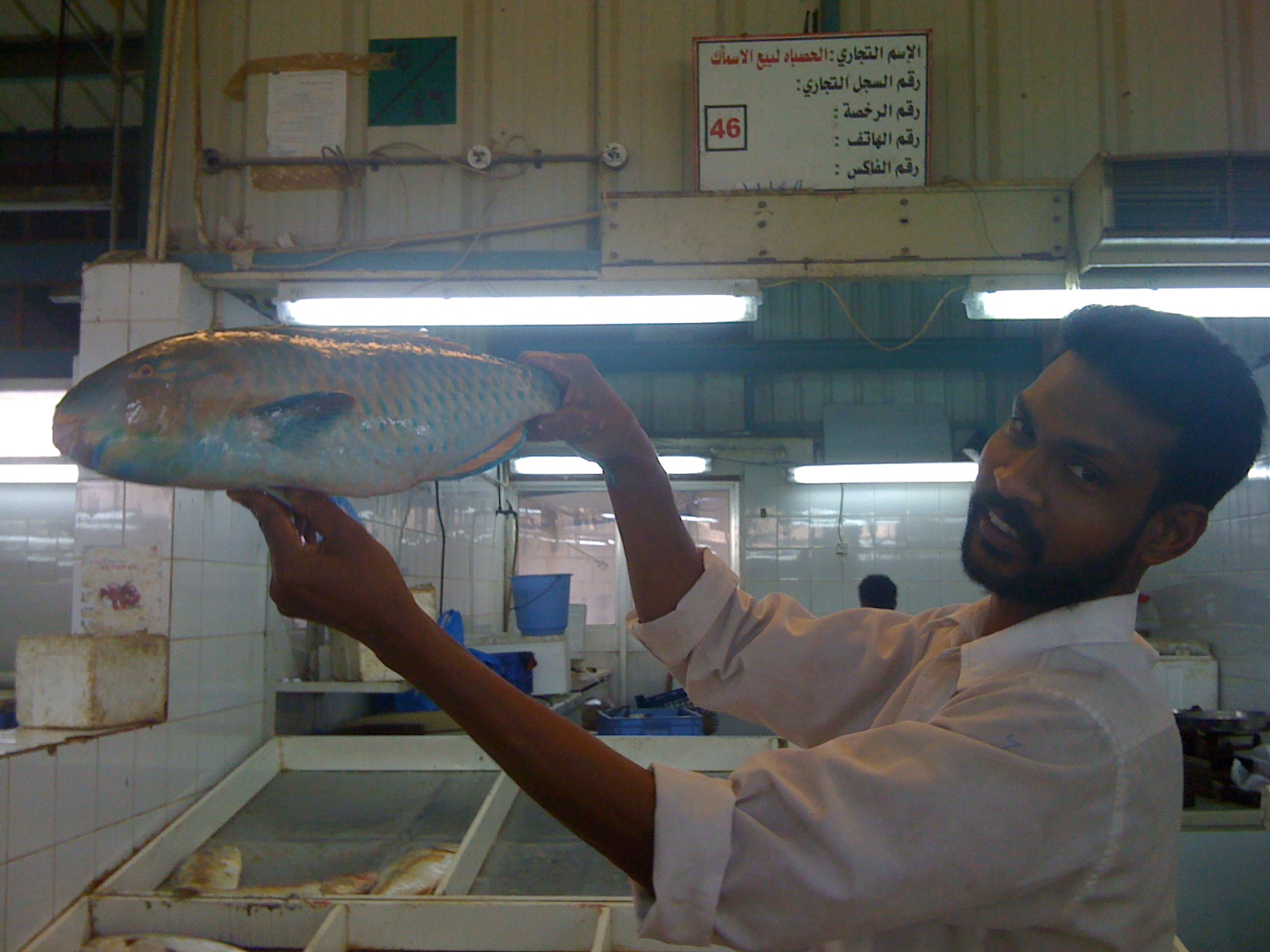
Above are some gorgeous parrotfish which apparently are from "Doha." The traders, while lovely and nice, said that everything was "from Doha."

Rays, above.

A very cheery trader holding up one of his prized rays. Now, these might actually be from Doha. When I went to the Islamic museum last week, we saw a couple of cow-nosed rays in the bay.

More parrotfish...I love how they look like they're smiling. Did you know that some species of parrotfish secrete a mucous cocoon at night to mask its scent from predators? I didn't until I checked Wikipedia just now....

Groupers. According to the traders, groupers are what they call "hamour."
It's a menu item you see in almost every restaurant.

More parrotfish and a happy trader.


Needlefish. My trusty (or possibly not) Wikipedia page says that needlefish can jump out of the water at up to 38mph and tend to get excited by artificial light, so pose a threat to some fishermen, particularly in the Pacific Islands. They can get 'speared' when the fish try and jump over their boat.

A very wee shark that should still be in the water. We need Sonja Fordham from the IUCN Shark Specialist Group to tell us what kind it is.


Guitarfish! How cool are they....